Rodent abatement stops internal biological destruction, while mechanical exclusion terminates external building access. The trade-off between standard broadcast baiting and structural exclusion centers on longevity:…
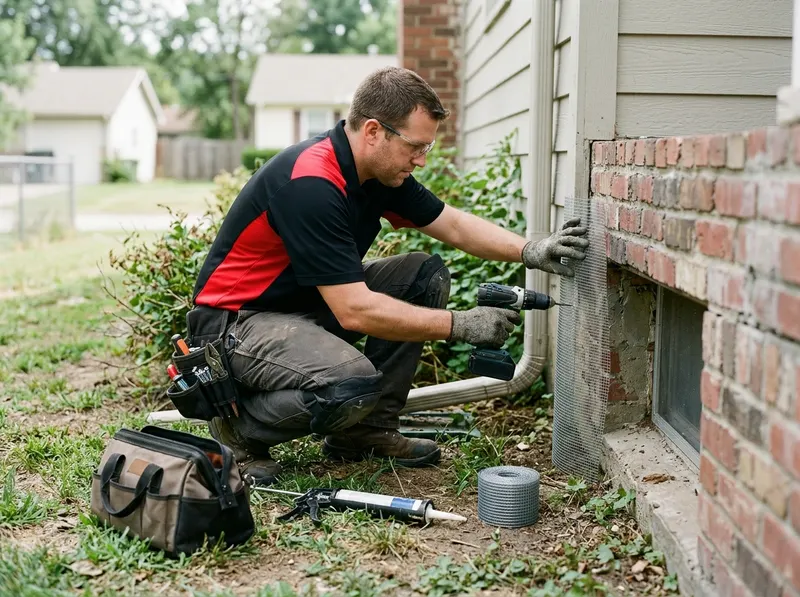
Rodent abatement stops internal biological destruction, while mechanical exclusion terminates external building access. The trade-off between standard broadcast baiting and structural exclusion centers on longevity: exterior broadcast bait stations temporarily depress local foraging populations, but leaving construction gaps unsealed invites replacement colonies within 30 to 60 days. In contrast, architectural exclusion with 19-gauge galvanized wire cloth permanently blocks entry points across brick ledges, siding kick-outs, crawlspace vents, and plumbing chaseways, preventing recurrent insulation fouling and gnawed electrical wiring.
Sedgwick County topography and Wichita housing inventory dictate specific rodent vulnerabilities. Along the Arkansas River corridor and Little Arkansas River in Delano and Riverside, Norway rats exploit softened sandstone foundations, broken sewer tie-ins, and low masonry crawl vents. In historic, mature neighborhoods like College Hill, Crown Heights, Forest Hills, and Sleepy Hollow, heavy tree canopies allow roof rats and field mice direct paths onto rooflines, where they penetrate warped soffits, dormer returns, and fascia overlaps. Homes in Orchard Breeze, South City, and Benjamin Hills regularly confront seasonal field-mouse migrations each autumn when ambient outdoor temperatures drop below 50 degrees Fahrenheit, driving rodents through gaps behind garage door weatherstripping and split utility penetrations near exterior air conditioning condensers.
1. Technicians conduct an exterior and interior structural baseline audit to identify rub marks, droppings, shredded cellulose, and perimeter entry points measuring 0.25 inches or larger. 2. Field operators place mechanical, child-and-pet-tamper-resistant capture stations in non-living structural voids, attics, and subfloor run lines to clear the residing colony without open chemical exposure. 3. Architectural sealants, concrete patches, and copper-steel mesh secure foundation sills, weep holes, crawl space access hatches, and roof intersections. 4. Follow-up monitoring checks capture rates over a two-week period to verify complete abatement before closing exterior staging zones.
Every job gets a firm, written price after a free on-site visit.
Tell us about your rodent exclusion and abatement job in Wichita and we'll send a clear, written quote, usually the same day.
 Halvex Extermination